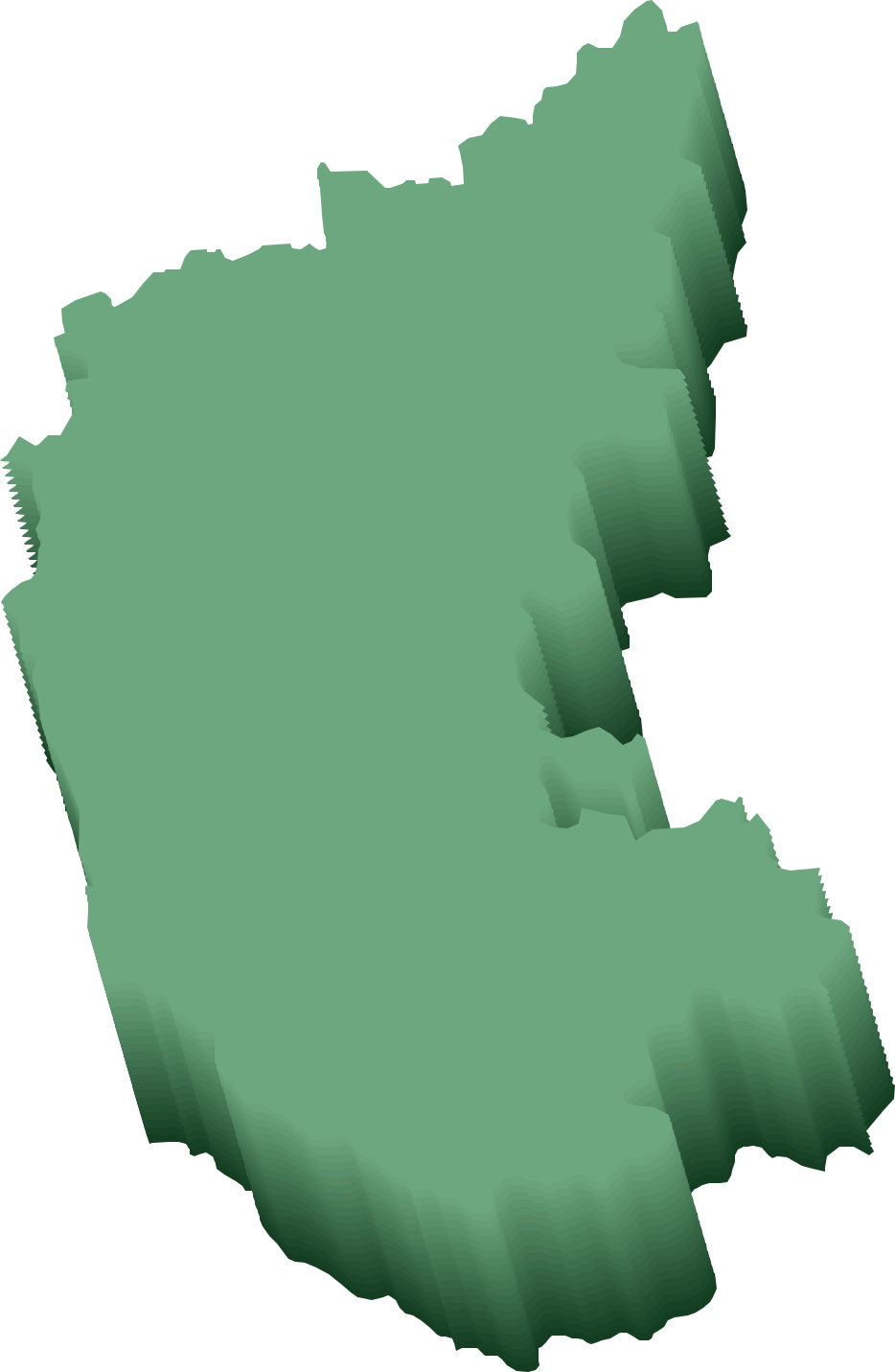
About Gadag District (Karnataka)
Historically, Gadag was called Kritapuri. It was named after sage Kritu. It is said that the sage overcome the region with the help of Lord Veera Narayana and requested the Lord to remain there. After that, Veeranarayana Temple came into existence. Gadag has been ruled by the Banas, Chalukyas, Rashtrakutas, and Hoysalas. Mughal king, Aurangzeb conquered Gadag was conquered by the Mughals and erected the Jumma Masjid. Jainnism has strong roots here. It was split from the Dharwad District in 1997 and became independent district.
The district has several notable personalities. Pandit Puttaraj Gawai was born on 3rd March, 1914. He was an Indian classical musician of Gwalior Gharana, a scholar, a music teacher and a social servant. He played many instruments such as the veena, the tabla, mridangam, violin, etc. He received the Padma Bhushan in 2008. Ram Shri Mugali (Ranganatha Srinivasa Mugali) was born on 15th July, 1906. He was also known as Rasika Ranga ("Romantic Ranga"). He was a famous writer in the Kannada language. He was awarded with the prestigious central Sahitya Akademi in 1956 for his work "Kannada Sahitya Charitre" in Kannada. He also held the position of the president of the 44th Kannada Sahitya Sammelana held in Siddganga, in the Tumkur district of Karnataka state, India.
Geographically, the district has total 4,657 sq. km. area and occupies the ranks 22nd in State and 247th in India. It lies at 15°43' N latitude, 75°63' E longitude and 628 m altitude. It is bounded by the Bagalkot District on the North, the Koppal District on the East, the Bellary District on the South-East, the Haveri District on the South-West, the Dharwad District on the West and the Belgaum District on the North-West. In the year 2023, there was a total 3.03% forest area of total geographical area of the district. The climate of the district remains pleasant almost throughout the year. Most of its rainfall occurs in the monsoon season. The actual rainfall in the district was 668.4 mm in the year of 2024-2025.
Administrative wise, the district is divided into 5 sub-districts. Moreover, it has 9 towns and 322 villages. Kannada is its official language. The district of Gadag came into existence on the 24th August, 1997, in the state of Karnataka with an allotted district code of 561. Gadag-Betageri is its district Headquarters which is located at a distance of 430 Km. from the State Capital.
Demographically, according to 2011 census, the district has a total number of 2,15,602 households with a total population of 10,64,570 including 5,37,147 are males and 5,27,423 are females. The density of population of the district is 229 persons per sq km. The sex ratio is pegged at 982 (females per 1000 males) while the child ratio stands at 947 (females per 1000 males). Furthermore, the district has an estimated projected population of 12,98,233 comprising 6,55,987 males and 6,42,246 females for the year 2026. According to the National Family Health Survey (NFHS-5, 2019–21), the district has an estimated sex ratio of 1,060 females and a child sex ratio of 909 females per 1,000 males. As per 2011 census the percentage of major religions practiced by the people of this region is Hindu at 85.27% and Muslim at 13.50%. According to the 2011 census, the percentage of other principal languages spoken in the region is Kannada at 85.32% and Urdu at 8.37%. The population growth rate during the period 2001 to 2011 was 9.54% including 8.84% were males and 10.27% were females. In the year 2023 the number of live births in the district was 17,496 out of which 9,093 were males and 8,403 were females. In the same year the number of deaths in the district was 9,886 out of which 5,620 were males and 4,266 were females.
Economically, agriculture is the prime source of income for the people of the district. In the year 2023-2024 the Gross Domestic Product in the district was Rs. 25,02,023 lakh at current price and Rs. 14,52,942 lakh at constant 2011-2012 prices. The Net Domestic Product in the district during the period 2023-2024 was Rs. 21,66,643 lakh at current price and Rs. 12,39,850 lakh at constant 2011-2012 prices. The Per Capita Income or NDDP, At Factor Cost in the district during the period 2023-2024 was Rs. 1,94,647 at current price and Rs. 1,11,386 at constant 2011-2012 prices.
Education wise, according to 2011 census, the literate rate in the district is 75.12% out of which 84.66% are males and 65.44% are females. The total literate population of the district is 7,00,177 out of which 3,97,178 are males and 3,02,999 are females. In addition, according to the Periodic Labour Force Survey (PLFS) for the period July 2023-June 2024 estimated literacy rate in the district is 84.05% including 89.21% are males and 78.93% are females (Age 7 Years and Above). The district has many primary, secondary schools and graduate colleges.
The district has many famous historical and religious places. These places are Veer Narayana Temple, Dambala Temple and Lakkundi. During the year 2016, total 264 foreign tourists and 85,685 domestic tourists visited the district. Veera Narayana Temple I said to have been built during the 11th century. Lakkundi is a example of western Chalukya architure. Now, there are many ruined temples such as Mallikarjuna, Virabhadra, Manikeshwara, Nanneshwara. It has 50 temples, 101 stepped wells and 29 inscriptions of Chalukyas, Kalachuris, Seuna and the Hoysalas dynasties. There are several Shiva temples and Jain temples and notable Jama Masjid in the Lakshmeshwara town. The town also has many smaller shrines, a dargah, the Kodiyellamma temple, the Mukha Basavanna shrine, and a gigantic idol of Suryanarayana.