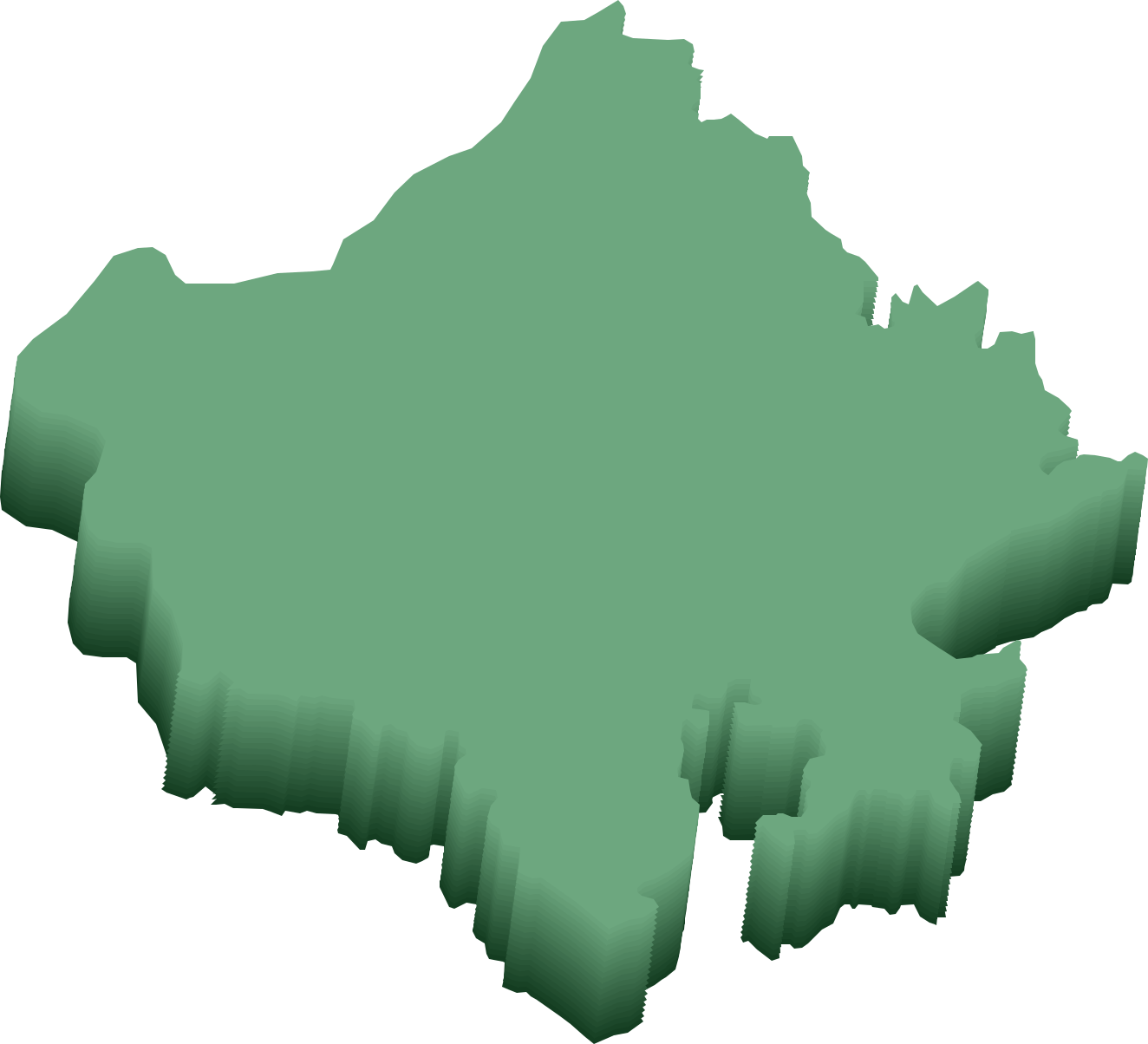
About Baran District (Rajasthan)
Historically, Baran was the part of Kota in pre-independence time. The district Baran is named after the district headquarters Baran. In the 14th-15th century, it was under Solanki Rajputs. It was believed that Baran was formed by twelve villages, was the reason behind its name ‘Baran’. Some feel, it is called 'Baran' because of the Barani soils of the area. Baran District became independent from Kota District on April 10, 1991.
Geographically, the district has a geographical area of 6,992 sq km and occupies the rank 19th in the State and 143rd in India on basis of this size. As per data recorded in the year 2023, there was a total 13.92% forest area of total geographical area. It lies at 25°09'N latitude, 76°51'E longitude and 262 m altitude. The prominent rivers hat flows through the district are Kali Sindh, Parvati River, Parwan River, Andheri and Ban-Ganga. It is bounded by Madhya Pradesh on the North and East, Jhalawar District on the South and South West and Kota District on the North West and West. The district has a dry climate except in the monsoon seasons. Most of its rainfall occurs in the monsoon season. The actual rainfall in the district was 1124.2 mm in the year of 2024-2025.
Administration wise, the district is divided into 8 sub-districts namely Baran, Anta, Atru, Mangrol, Chhabra, Chhipabarod, Kishanganj and Shahabad. Moreover, it comprises 8 towns and 1,221 villages. The district of Baran came into existence on 1st April, 1991 with its administrative headquarters located at Baran town. The administrative language in the district is Hindi.
Demographically, according to 2011 census, the district comprises total number of 2,40,321 households with a total of 12,22,755 including 6,33,945 are males and 5,88,810 are females. The population growth rate during the period 2001 to 2011 was 19.68% with 18.46% were males and 21.03% were females. The density of population of the district is 175 persons per sq km. The district has a sex ratio of 929 females for 1000 males while the child ratio stands at 912 females per 1000 males. Furthermore, the district has projected population of 14,91,138 comprising 7,74,140 males and 7,16,998 females for the year 2026. According to the National Family Health Survey (NFHS-5, 2019–21), the district has an estimated sex ratio of 1,019 females and a child sex ratio of 1,020 females per 1,000 males. The schedule caste population of the district is recorded as 2,21,184 including 1,14,969 are males and 1,06,215 are females. The schedule tribe population is 2,76,857 including 1,43,094 are males and 1,33,763 are females. As per 2011 census the major religion in the district is Hindu with 92.69% of the total population. According to 2011 census the principal language in the district is Hindi with 96.86%. In the year 2023 the number of live births in the district was 29,552 out of which 15,492 were males and 14,058 were females. In the same year the number of deaths in the district was 6,963 out of which 4,212 were males and 2,751 were females.
Economically, agriculture is the prime base of income of the district. Small scale industries also have great importance in the economic growth of the district. Tourism is main industry of income here. In the year 2023-2024 the Gross Domestic Product in the district was Rs. 25,24,210 lakh at current price and Rs. 13,95,071 lakh at constant 2011-2012 prices. The Net Domestic Product in the district during the period 2023-2024 was Rs. 22,90,749 lakh at current price and Rs. 12,48,186 lakh at constant 2011-2012 prices. The Per Capita Income or NDDP, At Factor Cost in the district during the period 2023-2024 was Rs. 1,57,506 at current price and Rs. 85,822 at constant 2011-2012 prices. Baran district has a NTPC Anta natural gas power station. There is another power station namely Kawai Thermal Power Station. It is coal-based thermal power plant, powered by Adani Power. Soyabean, maize, paddy, wheat, coriander, gram are main crops of the district. Guava, mango are produced primarily. Chemical, iron and steel, electric products, textiles, forest, paper, rubber, plastics industries are also found in the district. Bran district is known for high quality Tericot-Khadi.
According to 2011 census, the literacy rate in the district is 66.66% including 80.35% are males and 51.96% are females. In addition, according to the Periodic Labour Force Survey (PLFS) for the period July 2023-June 2024 estimated literacy rate in the district is 83.32% including 92.43% are males and 73.07% are females (Age 7 Years and Above).
The total literate population of the district is 6,93,307 including 4,32,607 are males and 2,60,700 are females. The district has a number of primary, higher and secondary schools and colleges. Some of its important educational institutions are Government P.G. College, Government Girls College, Kendriya Vidyalaya, Government Secondary School, etc.
The district has various historical and religious places which are great attractions for tourists from the worldwide. These places are Nahargarh Fort, Shergarh Fort, Sitabari, Manihara Mahadev Mandir, Kakoni, Bilasgarh, Kapildhara, Remains of Garhgachh, Shahabad Fort, ShahiJama Masjid, Shergarh Wildlife Sanctuary, and Tapasviyo ki Bagechi. It is believed that shergarh fort is named after Sher Shah Suri. Its old name was Kosavardhana. There is an inscription of Samanta Devadatta. Sitabari is a holy place. It is the birth place of Lav and Kush, sons of Bhagwan Ram. There are various Kunds in Sitabari namely Balmiki Kund, Sita Kund, Laxman Kund, Surya Kund, Lav-Kush Kund. Shahi Jama Masjid is situated in Shahabad city. It was constructed during the reign of Aurangazeb. Nahargarh fort is made up of red stone. It is an impressive structure of Mughal period. Tapasviyo ki Bagechi has large statues of Shivling and Nadiya. This place has natural beauty. It is surrounded by mountains. A number of fair and festivals are also celebrated here such as Dolmela, Sitabari Mela, Brahmani Mataji Mela, Piplod Christmas Fair, Phuldol Folk Festival, Urs-Balakhera etc. During the year 2024 there were 1,41,317 domestic tourists and 16 foreign tourists who visited these places of the district.