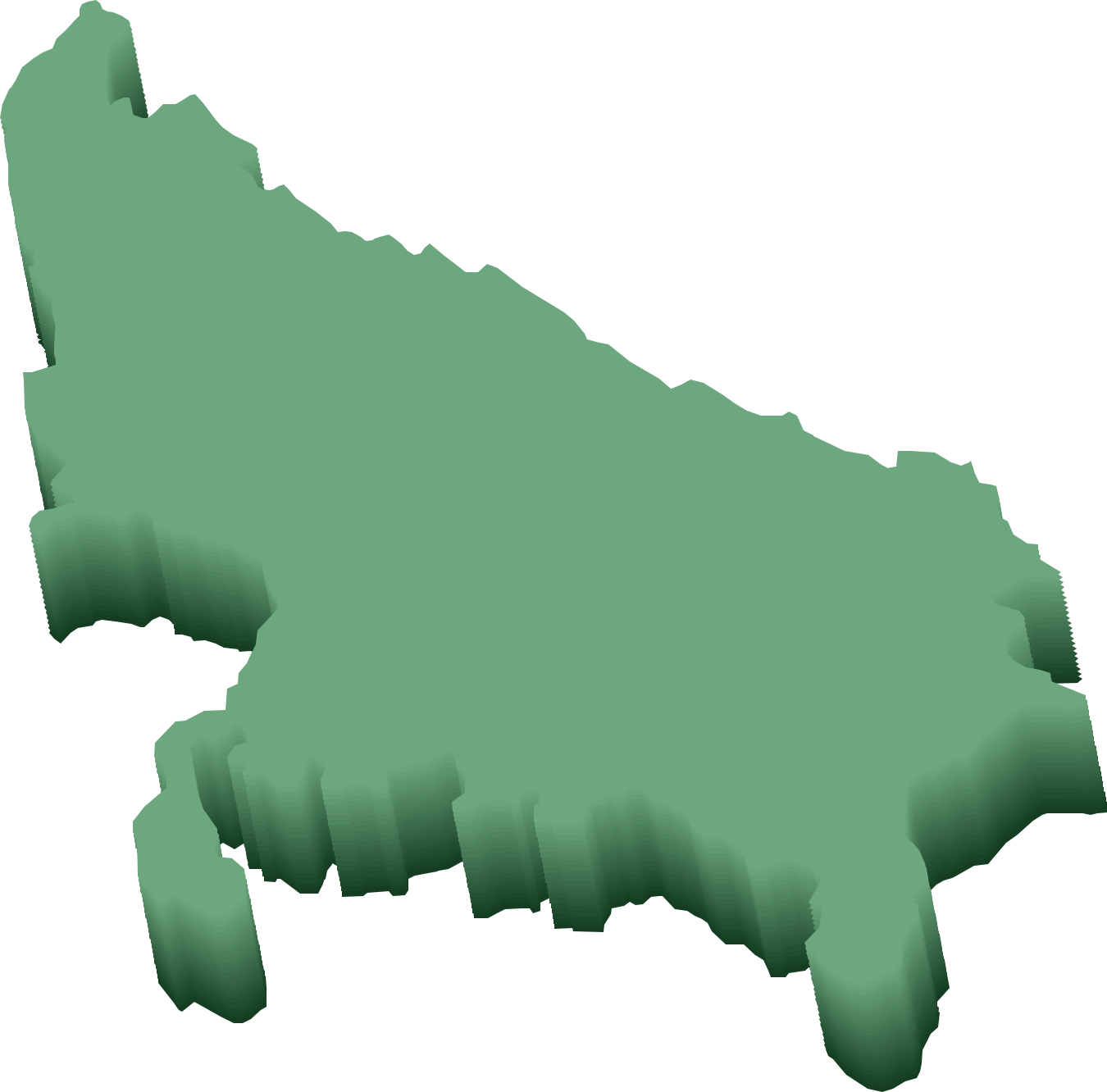
About Farrukhabad District (Uttar Pradesh)
Farrukhabad district, a part of Kanpur division is a district of Uttar Pradesh with its administrative headquarters located at Fatehgarh city. Nawab Mohammad Khan Bangash founded the district and named it after the Emperor Farrukhsiyar in 1714. Fatehgarh in the district got its name from an old fort. For a considerable period of time Fatehgarh remained a Military Station. Moreover it became the headquarters of the Governor Generals Agent for the ceded provinces in 1802. In the year 1818 a gun carriage factory was established here. During the medieval period, the district came under the rule of Ibrahim, the son of Sikandar Lodhi. Then he reached Kannauj where some other Afghan chiefs joined him and the place Kannauj became a part of the Mughal rulers. Later in 1769 Farrukhabad was attacked by the Marathas. From the period of 1780 to 1785 the British ruled and dominated the district at Fatehgarh. At the time of Indian struggle for independence the district also participated actively in the independence movement. The non-co-operation movement started by Mahatma Gandhi in August, 1920 had a great impact in the district as well. Most of its meetings and hartals were held at Farrukhabad, Fatehgarh, Kampil, Shamsabad, Kannauj, Indergarh and some other places too. In the year 1928 a complete Hartal was started where a large number of people staged demonstrations by marching in processions, waving black flags and carrying banners with the words “SIMON GO BACK”. Then in 1930 another prominent freedom struggle, the civil disobedience movement was started in the place of Farrukhabad. Moreover, salt was also manufactured at Sikandarpur, Bholepur, Chibramau and Kannauj. At that time Subhash Chandra Bose came to Farrukhabad on 25th January, 1940. Thus, the district also remembers those of its people who participated in the struggle for freedom. After India got its independence on 15th August, 1947, Farrukhabad as a separate district came into existence on 18th September, 1997.
Geographically, the district lies at 27°40'N latitude, 79°57'E longitude and 167 m altitude. In the year 2023, there was a total 2.31% forest area of total geographical area. The district encompasses a geographical area of 2,181 sq. km. and it is bounded by is bounded by Badaun district and Shahjahanpur district on the north, Hardoi district on the east, Kannauj district on the south and Etah district and Mainpuri district on the west. The climate of the district remains extremely hot during the summer and fairly cold during the winter. Most of its rainfall occurs in the monsoon season. The actual rainfall in the district was 650.8 mm in the year of 2024-25.
Administration wise, the district is divided into 3 tehsils namely Farrukhabad, Kaimganj and Amritpur. There are 1 Lok Sabha seat and 5 Assembly constituencies in the district. Moreover, the district comprises 9 towns and 1,005 villages. The administrative language in the district is Hindi.
According to 2011 the district has a population of 18,85,204 including 10,06,240 are males and 8,78,964 are females. The district has a sex ratio of 874 females for 1000 males. Furthermore, the district has projected population of 22,98,987 comprising 12,28,667 males and 10,70,320 females for the year 2026. According to the National Family Health Survey (NFHS-5, 2019–21), the district has an estimated sex ratio of 972 females and a child sex ratio of 752 females per 1,000 males. During the year 2001-2011 the population growth rate in the district was 20.05% out of which 18.41% were males and 21.98% were females. The population density in the district is 864 persons per sq. km. In the year 2023 the number of live births in the district was 39,637 out of which 20,237 were males and 19,400 were females. In the same year the number of deaths in the district was 11,401 out of which 7,622 were males and 3,779 were females. As per 2011 census the major religion in the district is Hindu with 84.67% of the total population. According to 2011 census the principal languages in the district is Hindi with 95.08%.
The economy of the district is basically based on agriculture. Farrukhabad is famous as the largest producer of potatoes. Some of its other chief agricultural products are wheat, watermelon, pulses, vegetables and oil seeds. Kaimgaj tehsil is a renowned producer of mangoes and guava. The adoption of the new agricultural technologies amongst the farmers of the district helps to increase the production of various agricultural items. Most of the population in the district are engaged in agriculture since it is scantily industrialized. In 2006 the Ministry of Panchayati Raj declared Farrukhabad as one of the country's 250 most backward districts which is currently receiving funds from the Backward Regions Grant Fund Programme (BRGF). In the year 2023-24 the Gross Domestic Product in the district was Rs. 16,20,734 lakh at current price and Rs. 8,24,015 lakh at constant 2011-2012 prices. The Net Domestic Product in the district during the period 2023-24 was Rs. 14,05,993 lakh at current price and Rs. 6,93,344 lakh at constant 2011-2012 prices. The Per Capita Income or NDDP, At Factor Cost in the district during the period 2023-24 was Rs. 63,084 at current price and Rs. 31,109 at constant 2011-2012 prices.
The district provides a platform for higher education. Some of its reputed educational institutions are Janta Inter College, R.P.P.G College, Sri Ram Swarup Inetr College, Shri Pursottam Singh Inter College, Shakti Sainik Inter College, Pandit Shri Puttu Lal Dubeyinter College, Puttu Lal Dubey Inter College, C.P.V.N Inter College, etc. As per 2011 census the literacy rate in the district is 69.04% including 77.4% are males and 59.44% are females. In addition, according to the Periodic Labour Force Survey (PLFS) for the period July 2023-June 2024 estimated literacy rate in the district is 77.14% including 82.57% are males and 72.29% are females (Age 7 Years and Above).
Khurshed Alam Khan, an eminent Indian politician and the first Muslim to serve as a minister in the foreign office was born on 5th February, 1919 at Pitaura village in the Farrukhabad district. He was also served as the Governor of Karnataka from 1991 to 1999 and Governor of Goa from 1989 to 1991. He was a senior leader of the Indian National Congress political party. Chandra Bhushan Singh, an illustrious Indian politician and a member of the 13th and 14th Lok Sabha from the Farrukhabad constituency was born on 14th October, 1944 in the Farrukhabad district. He is a member of Samajwadi party.
During the year 2023, there were 17,54,195 domestic tourists and 2,636 foreign tourists who visited these places of the district. Every year numerous travellers from different parts of the country as well as world come to this district to enjoy its various centres of attraction with historical and religious significance. Fatehgarh cantonment, situated near the Ganges River has 3 regiments namely, Rajput Regiment, Sikh Light Infantry and Territorial Army. The headquarters of civil administration of the district is located at Fatehgarh town. Kampil, situated at a distance of 45 km. from Farrukhabad is the birthplace of the 13th tirthankar, Brahlan Vimalnath. Sankisa, situated 47 km. away from Farrukhabad and natives of the district believe that it is the place where Buddha came to preach has an excavated Ashokan elephant pillar and a colossal Shiva Linga. Panchal Ghat is a pious place full of small ancient temples. People from across the country come to this place to offer their prayers. Pandaveshwar Mahadev temple, built by Pandavas during their Agyatwasa in Mahabharata period is a very well known temple of the district.