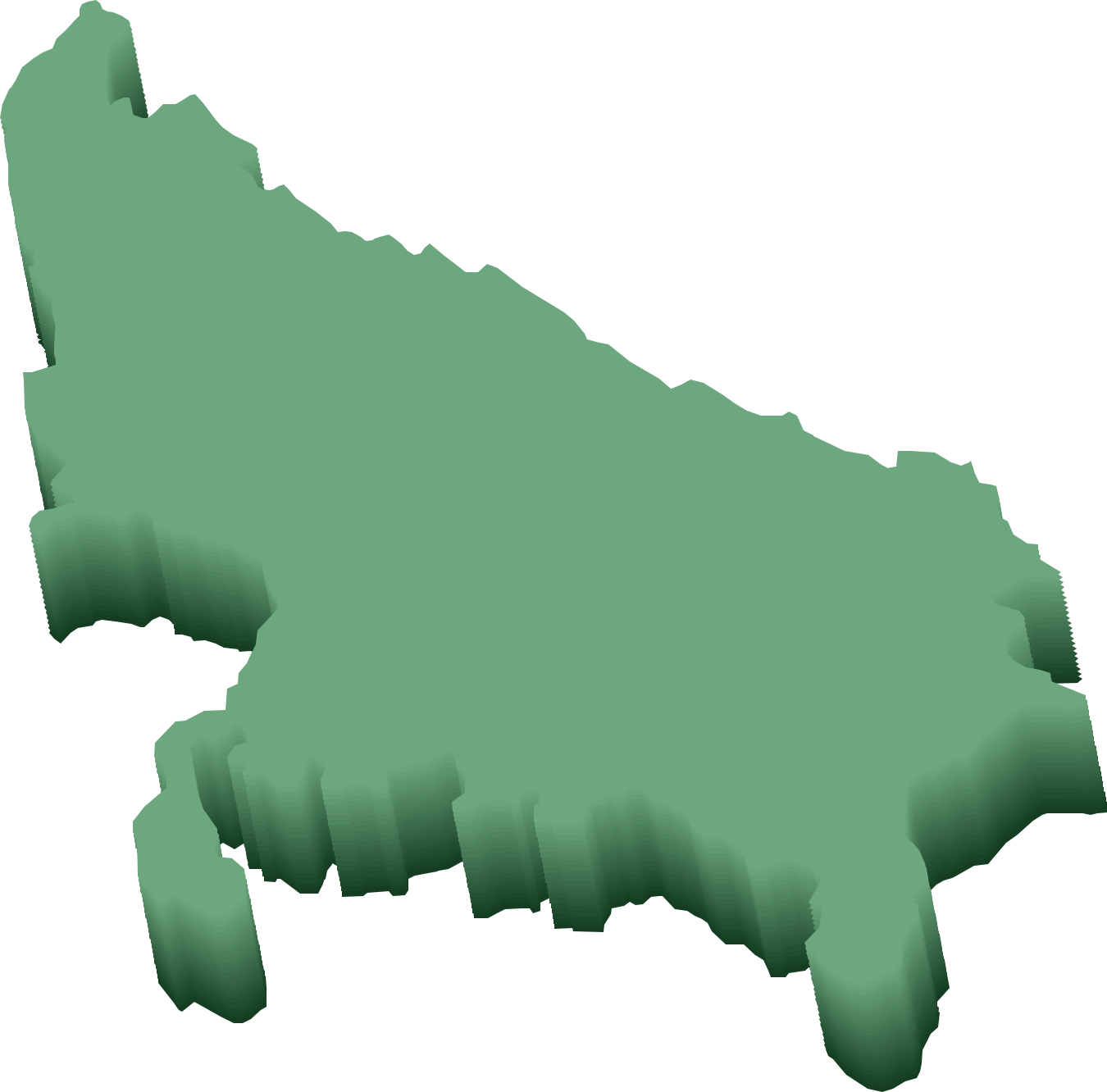
About Sant Ravidas Nagar / Bhadohi District (Uttar Pradesh)
Sant Ravidas Nagar, a part of Mirzapur division is a district of Uttar Pradesh with its administrative headquarters located at Gyanpur town. In terms of area the Sant Ravidas Nagar district is the smallest district of Uttar Pradesh. Earlier, the district was popularly known as Bhadohi. Its old name Bhadohi is derived from Bhar Raj of the place which made Bhadohi as its capital. The place has numerous mounds and old tanks which are named after the Bhar rulers, a tributary of Kannauj kingdom. After sometime the Mughal rule was started in the region and during the reign of Mughal Emperor Akbar, he made it a dastur and included it in the sarkar of Allahabad. In the 15th century, the place was went into the hands of Monas Rajputs and Sagar Rai was the first head of the clan. Then Jodh Rai, his grandson received the place as a zamindari sanad (deed) from the Mughal Emperor, Shah-e-Jahan. In 1911, Bhadohi came under the first Maharaja of the newly created princely state of Banaras which was ruled by Maharaja Prabhu Narayan Singh and till 1947 it was remained as a part of Banaras. Its previous name Bhadohi was changed to Sant Ravidas Nagar when the Mayawati government came into the power. It was carved out from the Varanasi district and emerged as a separate district in the year 1996.
Geographically, the district lies at 25°38’N latitude, 82°48’E longitude and 85 m altitude. In the year 2023, there was a total 0.51% forest area of total geographical area. The district encompasses a geographical area of 1,015 sq kms. and in terms of geographical area it occupies the ranks of 71st in the state and 578th in India. It is bounded by Jaunpur district on the north, Mirzapur district on the south, Varanasi district on the east and Allahabad district on the west. The prominent river that flow through the district is Ganga. The climate of the district remains extremely hot during the summer and fairly cold during the winter. The actual rainfall in the district was 487.5 mm in the year of 2024-25.
Administration wise, the district is divided into 3 tehsils namely Aurai, Bhadohi and Gyanpur. There are 1 Lok Sabha seat and 5 Assembly constituencies in the district. Moreover, the district comprises 3 sub-districts, 11 towns and 1,217 villages. The administrative language in the district is Hindi.
According to 2011 census the district has a population of 15,78,213 out of which 8,07,099 are males and 7,71,114 are females. The district has a sex ratio of 955 females for every 1000 males. Furthermore, the district has projected population of 19,24,615 comprising 9,85,624 males and 9,38,991 females for the year 2026. According to the National Family Health Survey (NFHS-5, 2019–21), the district has an estimated sex ratio of 1,082 females and a child sex ratio of 884 females per 1,000 males. During the year 2001-2011 the population growth rate in the district was 16.58% including 14.32% were males and 19.05% were females. The population density in the district is 1,555 persons per sq. kms. In the year 2023 the number of live births in the district was 29,755 out of which 15,728 were males and 14,027 were females. In the same year the number of deaths in the district was 7,867 out of which 5,102 were males and 2,765 were females. As per 2011 census the major religion in the district is Hindu with 86.70% of the total population. According to 2011 census the principal language in the district is Hindi with 97.76%.
The economy of the district is mainly based on agriculture. Most of the lands in the district are used for agricultural purposes. Some of its chief agricultural products are rice, wheat, barley, sugarcane, etc. The adoption of the new agricultural technologies amongst the farmers of the district helps to increase the production of various agricultural items. Every year a huge chunk of revenue comes from the agricultural products helps in its economy to a great extent. More than half of the population in the district are engaged in agriculture since it is scantily industrialized. Only a few industries of carpets and rugs are available in the district. In the year 2023-2024 the Gross Domestic Product in the district was Rs. 13,01,413 lakh at current price and Rs. 7,10,711 lakh at constant 2011-2012 prices. The Net Domestic Product in the district during the period 2023-2024 was Rs. 11,15,819 lakh at current price and Rs. 5,95,324 lakh at constant 2011-2012 prices. The Per Capita Income or NDDP, At Factor Cost in the district during the period 2023-2024 was Rs. 61,323 at current price and Rs. 32,718 at constant 2011-2012 prices.
The district is an abode of numerous reputed educational institutions. It provides platform for higher education. Some of its recognised educational institutions are Kashi Naresh Post Graduate Collage (K.N.P.G), Ram Dev P.G. College, Buddhiram Dubey Mahila Mahavidyalaya, Vimal Singh Mahavidyalaya etc. As per 2011 census the literacy rate in the district is 68.97% including 81.47% are males and 56.03% are females. In addition, according to the Periodic Labour Force Survey (PLFS) for the period July 2023-June 2024 estimated literacy rate in the district is 90.65% including 90.42% are males and 90.99% are females (Age 7 Years and Above).
Ramesh Dube, an eminent Indian politician and a member of 14th Lok Sabha from the Mirzapur constituency was born on 1st July, 1967 at Manikpur in the Bhadohi town. He is a member of the Bahujan Samaj Party. Gorakh Nath Pandey, an illustrious Indian politician and a member of 15th Lok Sabha from the Bhadohi constituency was born on 25th April, 1951 at Berawa Paharpur village in the district. He is a member of the Bahujan Samaj Party.
During the year 2023, there were 36,57,599 domestic tourists who visited these places of the district. The district has numerous centres of attraction with historical and religious significance which allures many travellers from different parts of the country as well as world. Among all the tourist spots of the district, the most popular one is the Sita Maddhi Temple which is located at a distance of 25 kms. from the district headquarter Gyanpur. Pilgrims from across the country come to this temple to offer their prayers. Some other notable places of interest in the district are Baba Harihar Nath Temple, Sai Dhaam, Chakwa Mahavir Mandir, Ghopaila Devi Mandir, Gyan Sarovar, Raja Park, Mukherjee Park, Gazimia Mazar, Semradh Nath, etc.