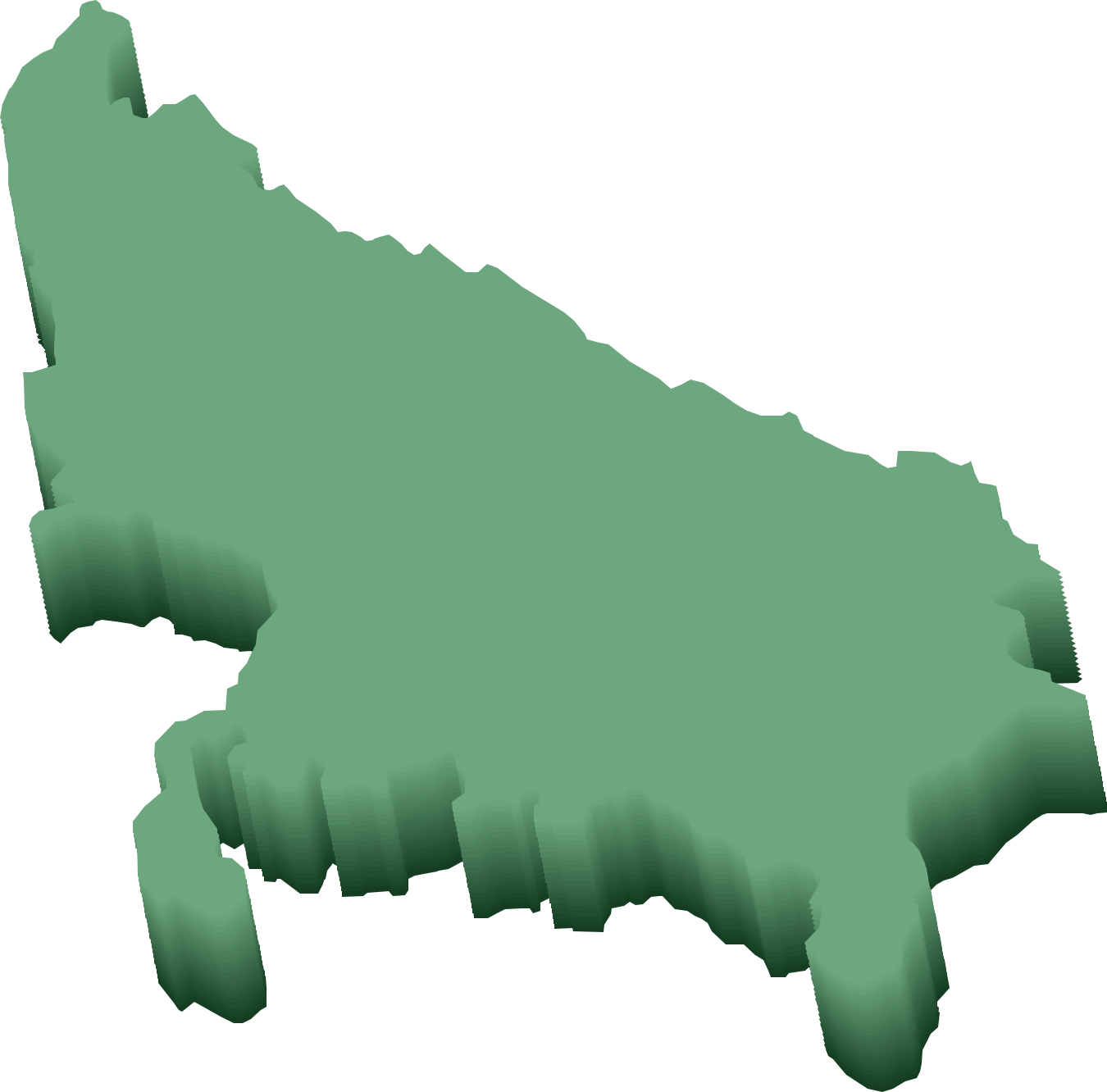
About Kanpur Dehat District (Uttar Pradesh)
Kanpur Dehat district, a part of Kanpur division is a district of Uttar Pradesh state with its administrative headquarters located at Akbarpur. The place got its name Kanpur from its original name Kanhapur which was given by the two rulers Hindu Singh of Sachendi and Ghanshyam Singh of Ramaipur. During the British rule, Hobson Johnson, a British ruler found the term difficult to pronounce and for this very reason he started to pronounce it as ‘Cawnpore’. With the passage of time the name of the place was changed to Kanpur. In the year 1977 the main Kanpur district was divided into two districts namely Kanpur Nagar and Kanpur Dehat. But in 1979 these two were reunited and again separated in 1981. After that, Akbarpur was announced as the district headquarters. Then on 1st July, 2010 the government of Uttar Pradesh announced to rename the Kanpur Dehat district as Ramabai Nagar district. After sometime in July 2012, it was again changed into its original name i.e. Kanpur Dehat.
Geographically, the district lies at 26°30'N latitude, 79°96'E longitude and 144 m altitude. In the year 2023, there was a total 1.56% forest area of total geographical area. The district encompasses a geographical area of 3,021 sq. km. and in terms of geographical area it occupies the ranks of 40th in the state and 391st in India. It is bounded by Kannauj district on the north, Auraiya district on the northwest, Jalaun district on the southwest and Kanpur Nagar district on the east. During summer the climate of the district remains extremely hot. Rainfall in the district mostly occurs in the monsoon season. The actual rainfall in the district was 444.3 mm in the year of 2024-25.
Administration wise, the district is divided into 5 tehsils namely Akbarpur, Bhognipur, Rasulabad, Derapur and Sikandara. There are 1 Lok Sabha seat and 4 Assembly constituencies in the district. Moreover, the district comprises 5 sub-districts, 12 towns and 1,029 villages. The administrative language in the district is Hindi.
According to 2011 census the district has a population of 17,96,184 including 9,63,255 are males and 8,32,929 are females. The district has a sex ratio of 865 females for every 1000 males. Furthermore, the district has projected population of 21,90,428 comprising 11,76,165 males and 10,14,263 females for the year 2026. According to the National Family Health Survey (NFHS-5, 2019–21), the district has an estimated sex ratio of 974 females and a child sex ratio of 1,131 females per 1,000 males. During the year 2001-2011 the population growth rate in the district was 14.89% out of which 14.08% were males and 15.85% were females. The population density in the district is 595 persons per sq. km. In the year 2023 the number of live births in the district was 28,010 out of which 14,543 were males and 13,467 were females. In the same year the number of deaths in the district was 8,933 out of which 6,185 were males and 2,748 were females. As per 2011 census the major religion in the district is Hindu with 89.80% of the total population. According to 2011 census the principal language in the district is Hindi with 98.99%.
Kanpur Dehat district is an agriculturally dominating district since its location favours agriculture. Therefore, agriculture is the backbone of the economy of the district. Most of the land in the district is used for the agricultural purposes. Moreover, the climatic conditions of the district are suitable for growing of different agricultural crops throughout the year. Some of its chief agricultural products are wheat, Paddy, rice, pulses, sugarcane, oil seeds, maize, potato, etc. Fisheries and animal husbandry also contributes in its economy to some extent. Almost all population in the district are engaged in agriculture as it is scantily industrialized. Kanpur Dehat district is one of the backward districts of the state. In the year 2023-2024 the Gross Domestic Product in the district was Rs. 24,51,718 lakh at current price and Rs. 14,21,879 lakh at constant 2011-2012 prices. The Net Domestic Product in the district during the period 2023-2024 was Rs. 20,99,407 lakh at current price and Rs. 12,06,696 lakh at constant 2011-2012 prices. The Per Capita Income or NDDP, At Factor Cost in the district during the period 2023-2024 was Rs. 1,02,657 at current price and Rs. 59,005 at constant 2011-2012 prices.
The district is an abode of numerous reputed educational institutions. It provides a platform for higher education. Some of its recognised educational institutions are Akbarpur Inter College, Galuwapur Inter College, Patel Vidyapeeth Inter College, Gram Vikas Inter College, Shri Gandhi Inter College, Bal Govind Sarvjanik Inter College, Janta Inter College, Gandhi Faze A Aam Tech. Inter College, Shri Ram Ratan Audyogik Krishi Inter College, Shri Krishnayurvedic Sanskrit Mahavidyalaya, etc. As per 2011 census the literacy rate in the district is 75.78% including 83.45% are males and 66.86% are females. In addition, according to the Periodic Labour Force Survey (PLFS) for the period July 2023-June 2024 estimated literacy rate in the district is 96.91% including 99.29% are males and 94.31% are females (Age 7 Years and Above).
Raja Ram Pal, an eminent Indian politician and a member of the 15th Lok Sabha from Akbarpur Lok Sabha Constituency was born on 20th November, 1960 at Siroh in Kanpur. Earlier, he was the member of the Bahujan Samaj Party (BSP) but later he joined the Indian National Congress party. Devendra Singh Bhole, an illustrious Indian politician and a member of 16th Lok Sabha was born on 2nd April, 1954 at Ranepur, Rasulabad in the Kanpur Dehat district. He is a member of the Bharatiya Janata Party. Earlier, he also won the 1993 and 1996 Vidhan Sabha Election from Derapur Assembly constituency of Kanpur Dehat.
During the year 2023, there were 7,13,281 domestic tourists who visited these places of the district. The district has numerous centres of attraction with historical and religious significance which allures many travellers from different parts of the country as well as world. Some of its well known temples are Bhitargaon temple, Jageshwar mandir, Isckon temple, Tapeshwari temple, etc. There are many Kos Minar or mile pillars on the Grand Trunk road passes through the district. Some of them are protected monuments such as Bhognipur, Chapar Ghata, Deosar, Gaur, Halia, Jallapur Sikandara, Pailwaru, Pitampur, Raigawan, Rajpur, Sankhiln Buzurg and Sardarpur.