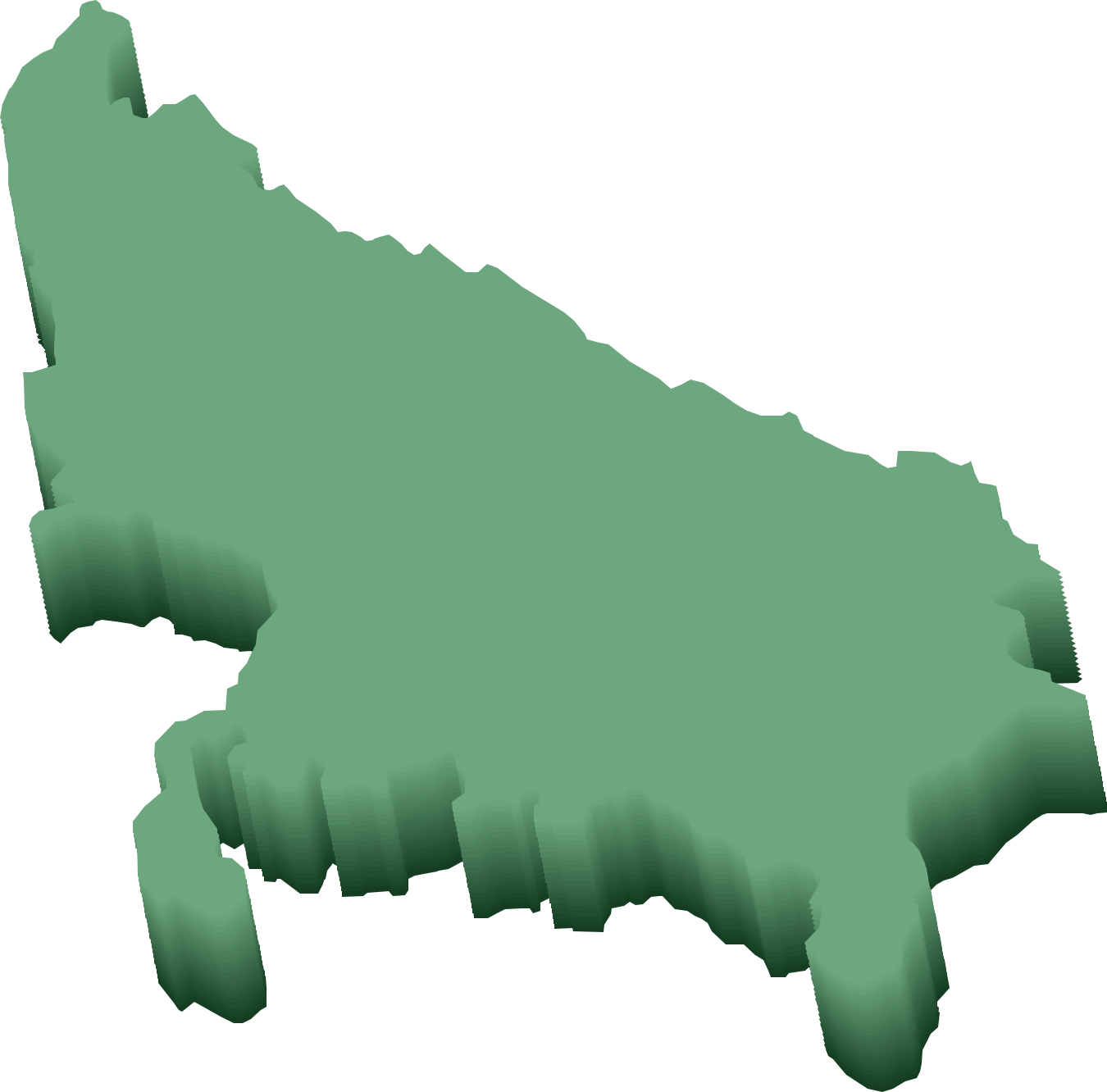
About Rampur District (Uttar Pradesh)
Rampur district, a part of Moradabad division is a district of Bihar state with its administrative headquarters located at Rampur city. At the very beginning Rampur comprised four villages altogether called Kather, the name of Raja Ram Singh. Nawab Faizullah Khan was the one who laid the first stone of the new fort at Rampur and thus, the city of Rampur was founded by him in 1775. Later, the first Nawab of the place Rampur renamed it as Faizabad. At that time there were also some other places with the same name Faizabad therefore the name of the place was again changed to Mustafabad, popularly known as Rampur. Nawwab Faizullah Khan ruled the region for 20 years. After his demise his son named Muhammad Ali Khan took over, but after 24 days of his rule he was killed by the Rohilla leaders and then his brother, Ghulam Muhammad Khan was proclaimed as Nawab. The place of Rampur was a prominent seat of Nawabs for a long period of time. Moreover, the Nawabs of Rampur sided with the British during India's First War of Independence in 1857, and hence this enabled them to continue to play a role in the social, political and cultural life of the Northern India in general and the Muslims of the United Provinces in particular. They also allow refuge to some of the literary figures from the Court of Bahadur Shah Zafar. On 1st July, 1949 the State of Rampur was merged into the Republic of India.
Shama Zaidi, an eminent Indian screenplay writer, costume designer, art director, theatre person, art critic, and documentary film maker was born in the Rampur city. Some of her famous filmographies are Charandas Chor, Garam Hawa, Manthan, Bhumika, Umrao Jaan, etc. Maulana Shaukat Ali, an illustrious Indian Muslim nationalist and leader of the Khilafat movement was born in the year 1873 in Rampur.
Geographically, the district lies at 28°80'N latitude, 79°03'E longitude and 179 m altitude. In the year 2023, there was a total 2.92% forest area of total geographical area. The district encompasses a geographical area of 2,367sq kms. and in terms of geographical area it occupies the ranks of 53rd in the state and 454th in India. It is bounded by Uttarakhand on the north, Bareilly district on the south and east and Moradabad district on the west. During summer the climate of the district remains extremely hot and in the winter it is fairly cold. The actual rainfall in the district was 824.1 mm in the year of 2024-25.
Administration wise, the district is divided into 5 tehsils including Rampur, Bilaspur, Milak, Shahabad, Swar and Tanda. There are 1 Lok Sabha seat and 5 Assembly constituencies in the district. Moreover, the district comprises 6 sub-districts, 10 towns and 1,163 villages. The administrative language in the district is Hindi.
According to 2011 census the district has a population of 23,35,819 out of which 12,23,889 are males and 11,11,930 are females. The district has a sex ratio of 909 females for every 1000 males. Furthermore, the district has projected population of 28,48,508 comprising 14,94,503 males and 13,54,005 females for the year 2026. According to the National Family Health Survey (NFHS-5, 2019–21), the district has an estimated sex ratio of 1,022 females and a child sex ratio of 1,067 females per 1,000 males. During the year 2001-2011 the population growth rate in the district was 21.42% including 19.55% were males and 23.55% were females. The population density in the district is 987 persons per sq. kms. In the year 2023 the number of live births in the district was 78,588 out of which 41,266 were males and 37,322 were females. In the same year the number of deaths in the district was 12,791 out of which 8,433 were males and 4,358 were females. As per 2011 census the major religions in the district are Hindu and Muslim with 45.97% and 50.57% of the total population. According to 2011 census the principal languages in the district are Hindi and Urdu with 73.99% and 23.04%.
Though the district is industrially well developed yet the economy of the district is mainly dependent on agriculture. The soil of the district is very fertile and most of its land is under agricultural use. The district has no mineral extraction area since it is not rich in mineral resources. Some of its chief agricultural products are paddy, wheat, barley, sugarcane, pulses, bajra, maize, potato, urd, moong, etc. Every year a huge chunk of revenue comes from these agricultural products. The foremost industries of Rampur are wine making, sugar processing, textile weaving and manufacturing of agricultural implements. Kite making industry is one of the oldest and core industries in Rampur. The knife of Rampur is popularly known as Rampuri Chaaku and it is famous across the country. Beedi making factories are also commonly found in it. In the year 2023-2024 the Gross Domestic Product in the district was Rs. 27,53,738 lakh at current price and Rs. 14,72,940 lakh at constant 2011-2012 prices. The Net Domestic Product in the district during the period 2023-2024 was Rs. 24,11,410 lakh at current price and Rs. 12,60,103 lakh at constant 2011-2012 prices. The Per Capita Income or NDDP, At Factor Cost in the district during the period 2023-2024 was Rs. 86,473 at current price and Rs. 45,187 at constant 2011-2012 prices.
The education institutions of the district attract not only the students of Rampur but also the students of the nearby places. Some of the reputed educational institutions in the district are Govt. Raza Degree College, Government Polytechnic, Govt. Murtaza Intermediate College, Saraswati Vidhya Mandir Inter College, Sunder Lal Inter College, etc. As per 2011 census the literacy rate in the district is 53.34% including 61.4% are males and 44.44% are females. In addition, according to the Periodic Labour Force Survey (PLFS) for the period July 2023-June 2024 estimated literacy rate in the district is 74.79% including 82.57% are males and 65.98% are females (Age 7 Years and Above).
During the year 2023, there were 39,44,084 domestic tourists and 290 foreign tourists who visited these places of the district. Every year numerous travellers from different parts of country as well as world come to this place to enjoy its beautiful centres of attraction. Raza Library in Rampur was built by Nawab Faizullah Khan, who ruled Rampur from 1774 to 1794. It is one of the biggest libraries of Asia. The construction of the Rampur Planetarium is almost completed and it will be India's first planetarium based on Digital Laser technology. Gandhi Samadhi, located in the Rampur city is a memorial to our Father of the Nation, Mahatma Gandhi. Kothi Khas Baghis, situated at a distance of 30 kms. east of Moradabad is a wonderful palace. The architecture of this European style palace is a unique blend of Islamic architecture and British architecture. Ambedkar Park in Rampur is a memorial to the Father of our Indian Constitution, Bhimrao Ambedkar.