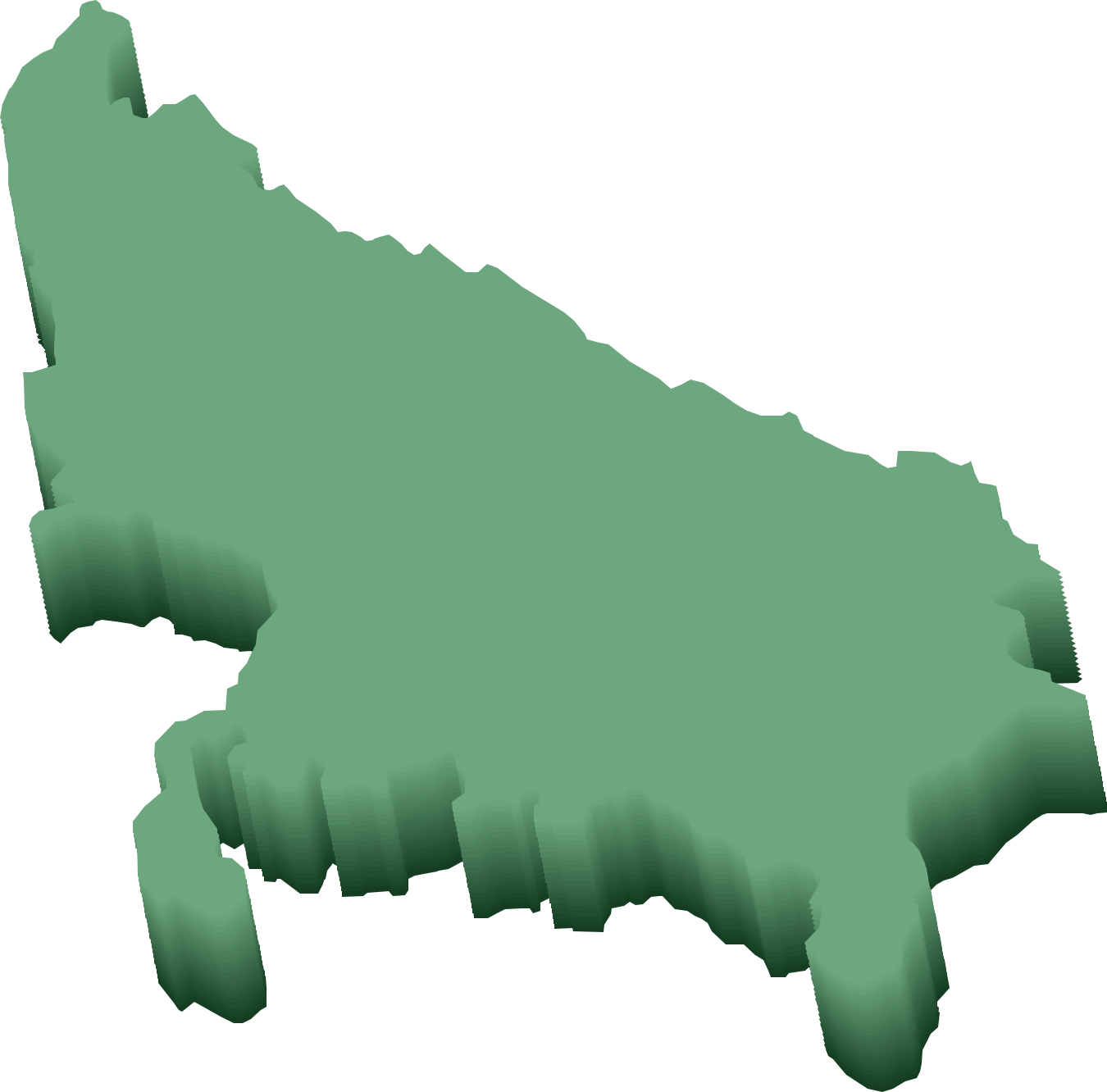
About Sant Kabir Nagar District (Uttar Pradesh)
Sant Kabir Nagar district, a part of Basti division is a district of Uttar Pradesh state with its administrative headquarters located at Khalilabad town. The district got its name from the mystic poet of 15th century called Kabir, who lived in Maghar town in the district. There is an interesting story associated with the burial rites of this great man Kabir. After the death of this Sant, his Muslim and Hindu devotees were fought over his proper burial rites. Then a miracle led to the settlement of the fighting of these two communities which they interpreted as a sign of divine intervention. The tomb or Dargah and also the Samadhi Mandir of Kabir are still present in Maghar town, side by side. Sant Kabir Nagar district was emerged as a separate district in the map of Uttar Pradesh on 5th September, 1997. After some time, 131 villages of the Basti district and 161 villages of the Siddharth nagar district became a part of the newly formed Sant Kabir Nagar district.
Geographically, the district lies at 26°76'N latitude, 83°08'E longitude and 75 m altitude. In the year 2023, there was a total 0.86% forest area of total geographical area. The district encompasses a geographical area of 1,646 sq kms. and in terms of geographical area it occupies the ranks of 65th in the state and 531st in India. It is bounded by Siddharthnagar district on the north, Ambedkar Nagar district and Azamgarh district on the south, Gorakhpur district on the east and Basti district on the west. The prominent rivers that flows through the district are Kuwano and Kathinayya. The climate of the district remains extremely hot during the summer. Most of its rainfall occurs in the monsoon season. The actual rainfall in the district was 1091.6 mm in the year of 2024-25.
Administration wise, the district is divided into 3 tehsils namely Khalilabd, Menhdawal and Dhanghata. There are 1 Lok Sabha seat and 3 Assembly constituencies in the district. Moreover, the district comprises 3 sub-districts, 6 towns and 1,726 villages. The administrative language in the district is Hindi.
According to 2011 census the district has a population of 17,15,183 including 8,69,656 are males and 8,45,527 are females. The district has a sex ratio of 972 females for every 1000 males. Furthermore, the district has projected population of 20,91,649 comprising 10,62,045 males and 10,29,604 females for the year 2026. According to the National Family Health Survey (NFHS-5, 2019–21), the district has an estimated sex ratio of 1,185 females and a child sex ratio of 919 females per 1,000 males. During the year 2001-2011 the population growth rate in the district was 20.77% out of which 20.88% were males and 20.66% were females. The population density in the district is 1,042 persons per sq. kms. In the year 2023 the number of live births in the district was 39,995 out of which 21,128 were males and 18,867 were females. In the same year the number of deaths in the district was 9,789 out of which 6,214 were males and 3,575 were females. As per 2011 census the major religion in the district is Hindu with 75.83% of the total population. According to 2011 census the principal languages in the district are Hindi and Urdu with 90.42% and 9.54%.
Agriculture is the backbone of the economy of the district. Most of the lands in the district are used for agricultural purposes. Some of its chief agricultural products are wheat, paddy, sugarcane, oilseeds, potato, maize, pulses, etc. More than half of the population in the district are engaged in agriculture since it is scantily industrialized. A few small-scale industries of brassware, iron and carpentry goods, agricultural implements, bricks, agro-products, foot-wear, soaps, candles, pottery, hosiery, combs, etc. are available in the district. In 2006 the Ministry of Panchayati Raj declared Sant Kabir Nagar as one of the country's 250 most backward districts that is currently receiving funds from the Backward Regions Grant Fund Programme (BRGF). In the year 2023-2024 the Gross Domestic Product in the district was Rs. 12,09,117 lakh at current price and Rs. 6,36,591 lakh at constant 2011-2012 prices. The Net Domestic Product in the district during the period 2023-2024 was Rs. 10,54,256 lakh at current price and Rs. 5,39,776 lakh at constant 2011-2012 prices. The Per Capita Income or NDDP, At Factor Cost in the district during the period 2023-2024 was Rs. 51,724 at current price and Rs. 26,482 at constant 2011-2012 prices.
The district is an abode of numerous reputed educational institutions. It provides platform for higher education. Some of its recognised educational institutions are Sardar Patel Degree College, Government Mahila Degree College, Janata Vaidik Degree College, Hira Lal Ram Niwas P.G. College, G.P.S. Mahavidyalaya, Awadh Center of Education for Women, Sant Ram krishan Pramhans Mahavidyalaya, etc. As per 2011 census the literacy rate in the district is 66.72% including 78.39% are males and 54.8% are females. In addition, according to the Periodic Labour Force Survey (PLFS) for the period July 2023-June 2024 estimated literacy rate in the district is 71.88% including 88.20% are males and 59.60% are females (Age 7 Years and Above).
During the year 2023, there were 12,87,099 domestic tourists and 80 foreign tourists who visited these places of the district. The district has numerous centres of attraction with historical and religious significance which allures many travellers from different parts of the country as well as world. The foremost places of interest in the district are Khalilabad City, Kabir Samadhi, Bakhira Lake, Buddhist Stoops, Takiyawa Fair Ground, Baba Tameshwar Nath temple, Barakhal Durga Mata temple, etc.